Three Legs of a Life Well Lived
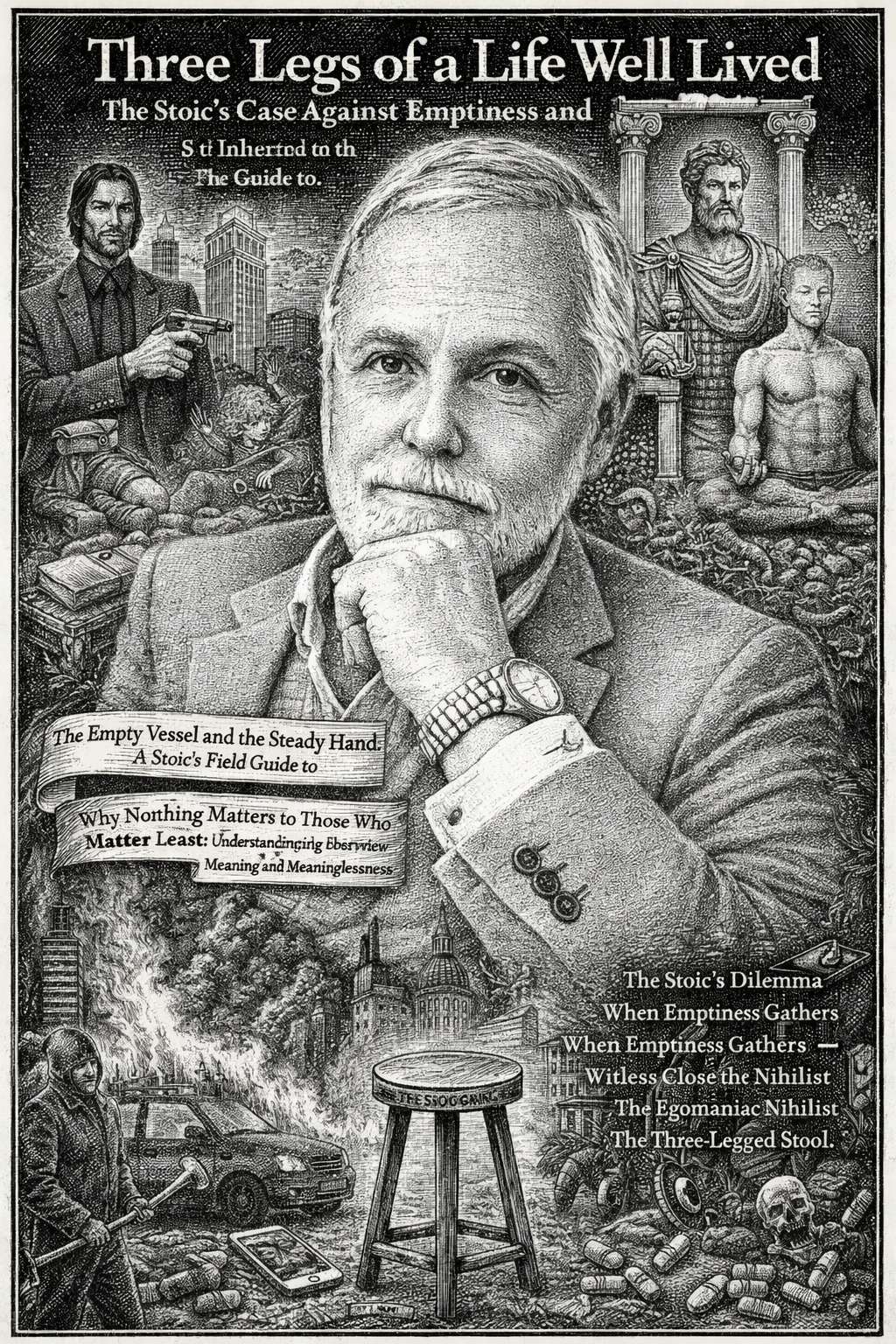
Three Legs of a Life Well Lived: The Stoic’s Case Against Emptiness and the Path to Genuine Achievement
The Empty Vessel and the Steady Hand: A Stoic’s Field Guide to
Why Nothing Matters to Those Who Matter Least: Understanding the Dangerous Dance Between Meaning and Meaninglessness
By Paul Grant Truesdell, J.D, AIF, CLU, ChFC, RFC
Thursday, January 29, 2026
Ocala, Florida
A Portion of My Magnum Opus
INTRODUCTION
This examination of Stoicism and nihilism strips away the academic pretense and gets to what actually matters in navigating modern life. It traces the line from ancient philosophy to the streets of Minneapolis, from Marcus Aurelius to the chemically altered agitators standing in front of moving traffic. The connections are uncomfortable but undeniable. Mental illness statistics, pharmaceutical interventions, online radicalization, and the deliberate weaponization of empty people by those with agendas all converge into a pattern that explains much of what we witness today but rarely discuss openly. This is not a theoretical exercise. It is a practical guide for recognizing the nihilists among us, understanding why they behave as they do, and making informed decisions about where to invest your finite time and emotional reserves.
The wisdom contained here is as urgent now as it was when Stoic philosophers first articulated these principles two thousand years ago. Human nature has not changed. The emptiness that drives destruction has not changed. What has changed is the scale, the speed, and the tools available to those who would exploit the lost for their own purposes. Whether you seek to protect yourself from corrosive influences, understand the forces tearing at the fabric of civil society, or simply build a life worth living in chaotic times, this collected thought offers a framework that has stood the test of centuries. The question it poses is simple. Will you build something, or will you be used by someone who builds nothing?
THE FUNDAMENTAL DIVIDE
Stoicism and nihilism both confront the indifference of the universe, but they arrive at opposite conclusions about what to do with that information.
The Stoics look at a world full of chaos, loss, and things beyond human control and say, “Fine. We’ll focus on what we can control.” That means your own thoughts, your own reactions, your own character. Everything else, whether fortune or misfortune, is considered an external to be accepted with equanimity. The universe might not care about you, but that doesn’t mean life lacks meaning. Meaning comes from living virtuously, from fulfilling your role as a rational being, from contributing to the common good. Marcus Aurelius rules an empire while reminding himself that even emperors turn to dust. The point isn’t to despair at that fact but to use it as motivation to act well today.
Nihilism takes the same observation, that the universe is indifferent, and concludes there’s no inherent meaning at all. No objective purpose. No cosmic scoreboard tracking your virtues. In its starkest form, nihilism suggests that without God or some external guarantor of meaning, all values are arbitrary, all efforts ultimately pointless. Why bother?
Here’s the irony: both philosophies can lead to a certain calm. The Stoic achieves tranquility through acceptance and right action. The nihilist might achieve a kind of peace through detachment, figuring if nothing matters, there’s nothing to get worked up about. But one builds something with that calm while the other risks building nothing at all.
The Stoics are practical people. Senators, slaves, emperors. They have lives to live and work to do. Their philosophy is a toolkit for engaging with the world effectively. Nihilism, at least in its passive forms, tends toward withdrawal or paralysis.
Perhaps the most useful distinction is this: Stoicism says meaning isn’t handed to you by the universe, so you create it through how you live. Nihilism says meaning isn’t handed to you by the universe, full stop. One philosophy treats the absence of cosmic meaning as a starting point. The other treats it as a destination.
For someone actually trying to navigate life, that difference matters quite a bit.
THE STOIC’S DILEMMA
A true Stoic has no use for the nihilist. Not out of cruelty, mind you, but out of practical necessity. The Stoics understand that your associations shape your character the way water shapes stone. Slow, steady, and eventually permanent. When you spend time around people who believe nothing matters, who dismiss effort and virtue as pointless exercises in self-delusion, that corrosive worldview seeps into your own thinking whether you notice it or not.
The nihilist presents a particular problem because they occupy a mental space the Stoic cannot reach with reason or persuasion. You can argue with someone who holds different values. You can debate priorities, discuss evidence, find common ground. But what do you say to someone who rejects the entire premise that anything has value at all? It’s like trying to convince someone to play chess when they insist the board doesn’t exist. There’s no move you can make because they’ve opted out of the game entirely.
This puts the Stoic in an uncomfortable position. The philosophy teaches compassion, patience, and understanding toward human frailty. We’re all struggling, after all. But it also teaches wisdom about where to invest your limited time and energy. And the nihilist represents what you might call a dead end investment. You can pour attention, care, and rational argument into that relationship until you’re exhausted, and you’ll get nothing back but the same empty shrug. Nothing matters. Why try?
So the Stoic, when given the choice, excommunicates the nihilist from their circle. Not with anger or judgment, just with the quiet recognition that some people cannot be helped by anything you have to offer.
The trouble is, life doesn’t always give you that choice. You work with nihilists. You’re related to them. They show up at social gatherings and community meetings. You can’t always avoid them, so you learn to navigate around them instead. You keep interactions brief and transactional. You don’t engage with the philosophical black hole. You treat them the way you’d treat bad weather, something to acknowledge, account for, and move through without letting it ruin your day.
Because at the end of the day, their emptiness is their problem. You’ve got a life to build.
WHEN EMPTINESS GATHERS
When nihilists gather together, they create something dangerous. A pity party with consequences.
Consider the two extremes. On one end you have the voluntary homeless nihilist. This person has checked out completely. They drift through life as vagabonds, maybe collecting welfare benefits, maybe accepting charity handouts, maybe not. They don’t care either way. They’ve decided the game isn’t worth playing, so they sit on the sidelines and wait for the clock to run out. Sad, certainly. But mostly harmless to anyone but themselves.
The other extreme is where the real trouble begins. These nihilists understand how systems work. They view society not as something to participate in but as something to exploit. Government programs exist to be gamed. Charitable organizations exist to be milked. The social contract exists to be violated by people clever enough to get away with it. They’re subsidized cynics living off the productive labor of people who still believe in something.
But here’s what makes them genuinely dangerous. Because they believe nothing matters, they’re easily manipulated by people who believe something matters very much. A nihilist with no purpose becomes a perfect tool for someone else’s purpose. They become agitators, disruptors, protesters who can be pointed at any target and told to cause chaos. They make excellent violent pawns precisely because they have nothing to lose and nothing they care about protecting.
Edward Banfield wrote about this phenomenon in The Unheavenly City Revisited. He identified a present-oriented time horizon as a defining characteristic of the underclass. People who cannot defer gratification, who cannot plan for next year or next month or even next week, who live entirely in the moment. The nihilist fits this profile perfectly. Why plan for a future you believe is meaningless?
The phrase useful idiots applies here with uncomfortable precision. These are people weaponized by ideologues who understand that an empty vessel makes the most noise. The nihilist thinks they’re rejecting society. In reality, they’re just being used by someone smarter who figured out how to aim their emptiness.
Minnesota provides a perfect incubator for this particular breed of nihilist agitator. Consider the environment. Long winters that stretch into spring. Darkness that descends at four in the afternoon and doesn’t lift for months. Cold that seeps into your bones and keeps you indoors staring at screens, marinating in whatever grievance the algorithm feeds you next. Add an urban setting where anonymity is easy and accountability is rare. You’ve got a recipe for trouble.
Into this environment steps the opportunistic nihilist. This person doesn’t care about George Floyd or climate change or Palestine or whatever cause happens to be trending this week. The cause is irrelevant. It’s just the flavor of the day, the excuse to gather with like-minded empty vessels and create chaos. Because chaos feels good when you believe nothing matters. Breaking things provides a momentary rush of significance to people who’ve convinced themselves significance doesn’t exist. It’s a contradiction they’re too far gone to recognize.
Watch their behavior and the nihilism becomes obvious. They stand in front of moving cars. They block traffic on highways. They put themselves in positions where any rational person who valued their own life would never stand. A Stoic wouldn’t do this. Someone who believes life has meaning and purpose wouldn’t gamble their existence for a viral video moment. But the nihilist? What do they have to lose? Nothing matters, remember?
This is why you don’t see Stoics at these protests. You see controlled, agitated, wound-up, manipulated, short-term time horizon nihilists who’ve been pointed at a target and released. They’re not building anything. They’re not solving anything. They’re experiencing the only pleasure available to someone who’s rejected the possibility of genuine fulfillment. Destruction as entertainment.
And here’s the profound connection most people miss. This group hates positivity. They hate success. They hate anyone who builds something, achieves something, accumulates something. Because success implies that effort matters. Achievement implies that life has meaning. Wealth implies that some approaches to existence work better than others. All of which contradicts the nihilist worldview.
This explains the visceral hatred for Donald Trump among this crowd. Forget policy disagreements. Forget political philosophy. Trump represents the ultimate rebuke to nihilism. A man who builds towers with his name on them. Who accumulates wealth unapologetically. Who wins and celebrates winning. Who radiates the message that life is a game worth playing and playing to win. To the nihilist, that’s the devil incarnate. Not because of what he does, but because of what he represents. The possibility that they’re wrong about everything.
THE STOIC RESPONSE TO VIOLENCE
A Stoic looks at a violent act and processes it with the clarity that comes from accepting reality as it is, not as we wish it were. An untimely death is unfortunate. That’s simply true. But an untimely death brought on by actions known to be dangerous? That’s a waste. And the Stoic understands that sympathy for those who waste themselves is an expense not worth having. Your emotional reserves are finite. Your capacity for grief is limited. Spending those resources on someone who deliberately placed themselves in harm’s way, who stood in front of traffic or charged at armed individuals or threw explosives at law enforcement, that’s a poor investment.
So when the Stoic sees a defensive shooting of a violent agitator, the response is measured. A roll of the shoulders. A raise of the brow. A purse of the lips. And the words that follow carry no malice and no celebration. Just observation. Oh well. Play stupid games, win stupid prizes. It’s not a condemnation of the person. It’s not dancing on a grave. It’s a statement of cause and effect as reliable as gravity. You chose the action. The consequence followed. The Stoic moves on.
But this measured response drives the nihilist absolutely insane.
To understand why, you have to understand what’s happening inside the nihilist’s mind, particularly when that mind has been chemically altered. The data here is striking and worth examining carefully.
According to a 2020 Pew Research study, young liberal women between the ages of 18 and 29 report mental health diagnoses at a rate of 56 percent. More than half. Compare that to young moderate women at 28 percent and young conservative women at 27 percent. For men, the numbers are lower across the board but follow the same pattern. Liberal men report mental health diagnoses at 34 percent, moderate men at 22 percent, and conservative men at just 16 percent.
These aren’t small differences. A young liberal woman is more than three times as likely to have a diagnosed mental health condition as a young conservative man. And that gap matters when we start talking about behavior, radicalization, and violence.
The pharmaceutical dimension makes this picture considerably darker. SSRIs, selective serotonin reuptake inhibitors, are prescribed at dramatically higher rates to women than to men. According to CDC data, women are nearly twice as likely as men to take antidepressant medications, with usage rates climbing sharply among white women in particular. These medications carry black box warnings about suicidal ideation and violent behavior, especially in young people. The warning labels exist for a reason. Psychotic thoughts, homicidal ideation, and emotional blunting that removes normal fear responses are documented side effects.
Now combine these factors. You have a population that skews heavily toward diagnosed mental illness. They’re medicated with drugs that can induce violent ideation and remove normal self-preservation instincts. They’ve embraced a nihilistic worldview that tells them nothing matters anyway. And they’re being actively courted by online communities that pander to their instability.
This pandering is deliberate. Far-left online communities specifically attract the mentally ill and then reinforce their most destructive tendencies. You can’t challenge bizarre thinking because that’s ableist. You can’t suggest someone seek help because that’s stigmatizing. You can’t point out that their behavior is self-destructive because that’s victim blaming. The community wraps its arms around the most unstable members and whispers encouragement. You’re not crazy. Society is crazy. You’re not broken. The system is broken. And the only way to fix it is to burn it all down.
This creates weaponized individuals who don’t care if they die. In fact, dying as a martyr might be the most meaning they’ve ever experienced. Remember, these are people whose lives lack significance. The nihilism that told them nothing matters left them hollow. But suddenly, through radicalization, they’re part of something bigger. They’re stopping Nazis. They’re saving democracy. They’re fighting fascism. For the first time, their empty existence has purpose, even if that purpose leads directly to their own destruction.
The man who took shots at ICE agents with a rifle knew how that encounter would end. The activists who block highways understand that vehicles weigh thousands of pounds. The agitators who throw frozen water bottles at police officers recognize that police officers are armed. They do it anyway. Because when you’ve already decided life is meaningless, what’s the downside of dying for a cause? At least you’ll be remembered. At least you’ll matter. At least your death will be celebrated by your online community as heroic sacrifice rather than mourned as the preventable tragedy it actually is.
When these chemically altered, mentally unstable, nihilistically radicalized individuals encounter the Stoic response to violence, something breaks inside them. The Stoic’s calm acceptance feels like an attack. The shrugged shoulders feel like mockery. The refusal to perform grief feels like endorsement of murder. Because the nihilist cannot comprehend someone who has made peace with reality. To the nihilist, the Stoic’s equanimity is proof of evil.
This is where the slope gets slippery. The nihilist starts with hatred of specific individuals. That commentator who said something offensive. That politician who represents everything wrong with America. But the logic of nihilism combined with mental instability doesn’t permit boundaries. If that person is evil, and they’re supported by those people, then those people are also evil. And if the system protects those people, then the system is evil. And if anyone defends the system, they’re evil too.
All better or bad. All white men are the enemy. All law enforcement is fascist. All forms of government that don’t align with the cause must be eliminated. This is not rational political philosophy. This is the terminal stage of nihilistic radicalization, where the emptiness inside demands that everything outside be emptied as well.
And they’ll follow the piper right off the cliff. Knowing it’s suicidal. Not caring. Because there is no meaning anyway, so what difference does it make?
This is what’s happening in Minnesota. This is what’s happening in Minneapolis. The cold and the darkness breed isolation. The isolation breeds despair. The despair attracts communities that validate mental illness rather than treat it. The communities radicalize their members toward violence. The medications remove whatever natural inhibitions might have remained. And the nihilistic worldview provides the final permission structure. Nothing matters. So why not burn it down?
The Stoic watches this unfold with the same measured response as always. Unfortunate. Wasteful. Predictable. And then moves on to build something worthwhile, leaving the nihilists to their destruction and self-destruction alike. Because you cannot save someone who doesn’t believe saving is possible.
THE WITLESS CLOSETED NIHILIST
The witless closeted nihilist walks among us every day, and most people never recognize them for what they are. This is the person who drifts through life without examining any of it. They adopt whatever belief happens to be fashionable this week. They nod along with whatever the crowd says. They’re clueless in the truest sense of the word, lacking any clue about what they actually believe or why they believe it.
The closeted part comes when they begin to sense something is wrong. Deep down, they recognize the contradictions in their thinking. They feel the disconnection between what they say and how they live. But instead of confronting that discomfort, they burrow deeper into the crowd. There’s safety in numbers, after all. Comfort among others who share the same unexamined assumptions. Why think when you can belong?
Here’s where it gets interesting. These people live nihilistic lives in every practical sense. Nothing they do today connects to any larger purpose. They chase distractions. They avoid difficulty. They float from one thing to the next without building anything permanent. And yet, they cling to a sliver of hope that exempts them from the full weight of their nihilism. That sliver is called life everlasting.
In Christianity and Islam, you find believers who hang their entire existence on the promise of heaven or paradise. Everything difficult about this life becomes tolerable because something better awaits. The suffering has meaning because it leads somewhere. But watch how these same people actually live. They’re not building. They’re not striving. They’re not engaging with the world as if it matters. They’re just waiting. Waiting for the next big thing. And the next big thing is always death, repackaged as a doorway to eternal reward.
The conundrum reveals itself when mortality comes knocking. These same people who profess absolute certainty about heavenly glory will spend a bloody fortune to avoid dying. They’ll drain retirement accounts for one more treatment. They’ll endure agonizing procedures to squeeze out another month. If heaven is so wonderful, why the desperate clinging to earth? The answer is they don’t really believe what they claim to believe. The nihilism runs deeper than the faith.
Judaism offers an interesting contrast here. Traditional Jewish theology focuses on this life, on righteous action in the here and now, with considerably less emphasis on afterlife specifics. The concept of Olam Ha-Ba, the world to come, exists but remains deliberately vague compared to Christian or Islamic descriptions of heaven. You don’t find Jewish scholars painting detailed pictures of paradise because that’s not the point. The point is how you live today.
This is why the great Stoics kept it simple. They didn’t need elaborate afterlife promises to find meaning. They found it in the living.
I’ve spent many decades coming to a very simple summary of Stoicism and that is this: if you wake up, you had a good night. If you go to bed, you had a good day. Anything else is not good.
Stoicism is living. Nirvana is peaceful individual coexistence. It is doing what one must do and avoiding what one knows is detrimental. It is associating with those who are like-minded and ignoring those who are not, until the non-Stoic becomes an impediment. And then you do what you must do without expending needless sympathy that drains the reserves of compassion needed to survive life.
THE EGOMANIAC NIHILIST
The egomaniac presents a fascinating psychological profile. This is someone whose sense of self expands to fill every room they enter. They believe, truly believe, that they are exceptional. Rules that apply to ordinary people don’t apply to them. Their opinions carry more weight. Their time is more valuable. Their contributions matter more. The egomaniac doesn’t just want recognition. They need it the way the rest of us need oxygen. Every interaction becomes an opportunity to reinforce their centrality to the universe. Every conversation eventually circles back to them.
Now recall what we know about the nihilist. This is someone who has concluded that nothing possesses inherent meaning. No objective purpose exists. No cosmic significance attaches to any human endeavor. The nihilist looks at morality, duty, obligation, and sees arbitrary constructs. Social contracts are fictions. Laws are suggestions enforced by power, not principle. The nihilist operates without the internal constraints that govern most human behavior because those constraints rest on foundations the nihilist has already rejected.
When you combine these two traits at extreme levels, something remarkable happens. You get individuals capable of extraordinary achievement precisely because they lack the limitations that hold everyone else back. The egomaniac provides the drive, the insatiable hunger for recognition and success. The nihilist provides the freedom from guilt, from second-guessing, from the paralysis that afflicts people who worry too much about whether their actions are right or wrong.
Look at the world of entertainment. The actors and musicians who reach the highest peaks often display this combination in abundance. They believe they deserve the spotlight, and they’ll do whatever it takes to stand in it. The casting couch exists because nihilistic egomaniacs sit on both sides of it. One has power and no moral compunction about exploiting it. The other wants fame badly enough to pay whatever price gets demanded. Neither loses sleep over it.
Corporate America runs on this same fuel. The executives who climb to corner offices are rarely the founders who built something from nothing. They’re bureaucrats who mastered the game. They manipulated performance reviews. They took credit for subordinates’ work. They sabotaged rivals with smiles on their faces. They said whatever needed saying in meetings and never intended to follow through. The nihilism allowed them to make promises without the burden of keeping them. The egomania convinced them they deserved the promotion anyway.
Government operates identically. Politicians stand at podiums and declare positions they’ll abandon the moment the political winds shift. Consider immigration. Donald Trump campaigned on border security and deportation, then actually attempted to implement those policies. The establishment lost its collective mind. But here’s what everyone conveniently forgets. Bill Clinton talked tough on immigration. Barack Obama deported millions and spoke about the need for enforcement. George Bush pushed for reform that included border security. They all said similar things when it suited them politically. The difference is Trump meant it, and they didn’t. The former presidents have kept their mouths shut during this current debate because they know their own records contradict the outrage they’d need to manufacture. They were nihilistic egomaniacs who said what voters wanted to hear. Trump, whatever else you think of him, actually believed what he was selling.
I exclude Joe Biden from this analysis deliberately. When someone reaches the point of cognitive impairment, fairness demands we stop treating them as a full participant in these discussions. You don’t kick a man when he’s down. I would extend the same courtesy to Ronald Reagan after he wrote that letter acknowledging his Alzheimer’s diagnosis. There’s no honor in attacking someone whose mind no longer allows them to defend themselves.
The titans of industry display this egomaniac-nihilist combination in varying degrees. Warren Buffett projects folksy wisdom while making decisions that affect millions of lives with cold calculation. Elon Musk tweets provocations at three in the morning, buys companies on impulse, and genuinely seems to believe the rules of business and society are suggestions he can ignore. It takes a high level of egomania coupled with nihilism to reach these heights. The ego provides the fuel. The nihilism removes the guardrails.
But here’s where everything we’ve discussed comes together. The egomaniac nihilist can achieve great things, but they leave wreckage in their wake. They use people and discard them. They build empires on foundations of broken promises. They succeed, but at what cost? And to what end?
THE THREE-LEGGED STOOL
The answer lies in adding a third element. The Stoic.
A one-legged stool falls over. A two-legged stool falls over. But a three-legged stool stands firm. This is why the triangle appears throughout human understanding as a symbol of stability. The trilogy. The pyramid. Maslow’s hierarchy of needs, rising from basic requirements for food and shelter all the way up to self-actualization. Three points create stability that two points cannot.
The Stoic who maintains equanimity, who possesses the drive and fervent dedication of the nihilist’s energy without the moral vacuum, who embraces the leadership requirements of egomania without descending into narcissism, that person achieves something rare. They build without destroying. They lead without exploiting. They succeed without losing their soul in the process.
Marcus Aurelius embodied this trilogy. He ruled an empire, which requires no small amount of ego. He made decisions affecting millions, which requires detachment from sentimental constraints. But he governed himself with Stoic discipline, recording private meditations about duty, virtue, and the proper use of power. He never published those writings. They were discovered after his death. He wasn’t performing wisdom for an audience. He was actually pursuing it.
Socrates demonstrated the same balance. Confident enough to challenge the most powerful men in Athens. Detached enough to accept his death sentence with equanimity. Grounded enough to spend his final hours discussing philosophy rather than raging against injustice.
This is the epitome of true success. Not mere achievement, which the egomaniac nihilist can accomplish. Not mere tranquility, which the passive Stoic might find in withdrawal from the world. But the combination of ambition, freedom, and wisdom that allows someone to build something lasting, lead others effectively, and maintain their integrity throughout.
The father, the son, and the holy spirit. The mind, the body, and the soul. The ego, the nihilist, and the Stoic. Three elements in balance, creating stability where any two alone would topple.
A life well lived, is a life well lived.