Not Your Typical
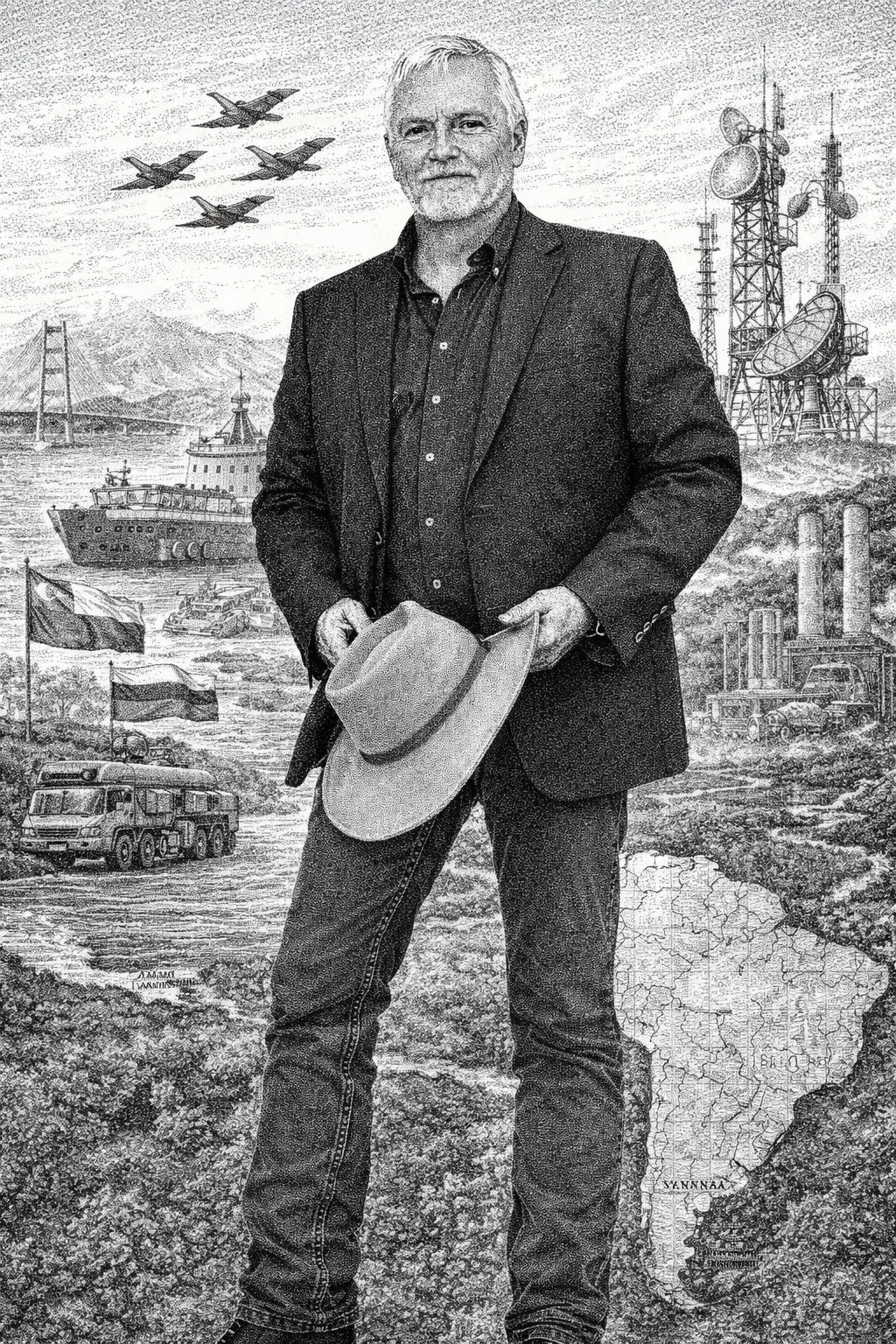
This is not your typical foreign policy lecture. What follows is a straightforward discussion of facts, figures, and geographic realities that explain why the United States is repositioning itself across Latin America. Despite what the Minnesota pearl fondling leftists are saying between their showers of mace and ear drum numbing whistling, we are not building a colonial empire. Nobody is getting subjugated. The emphasis here is reasonable peace, tranquility, law and order within guardrails, and self-determination within those same guardrails. What we are witnessing is an expansion of the Monroe Doctrine, and it is long overdue. No more tiptoeing around when China shows up in Panama or Russia parks military assets in Venezuela or European interests start meddling south of the border. This approach reflects the vision Marco Rubio brings to the table, a unification of the Americas while respecting independent national status. But let us be clear-eyed about the hurdles ahead, because there are several and they are significant.
Start with the obvious. The United States possesses the most powerful military force not just in this hemisphere, not just on the planet, but in the entire span of human history. A significant reason for that dominance comes down to deployment capability. Over the past century, America built logistics infrastructure that allows it to push troops, ships, and firepower anywhere on earth within days. When you are talking about places like Venezuela, which sits just across the Caribbean, getting there presents no challenge whatsoever. The problem is not removing a government. If Washington decided tomorrow to remove every government in Latin America, the military operations would wrap up in a matter of weeks. The real question is what happens the morning after.
Latin American militaries possess zero deployment capability beyond their own borders. Part of this stems from economics. Projecting power requires a strong trade-based, technically advanced economy to back military operations somewhere else. Part of it traces back to a persistent technological gap. The British Empire taught the world that when you possess industrial technologies nobody else has, you can bring a gun to a knife fight and run the show for a century or two until everyone else catches up. The Anglo nations, Americans included, have maintained that technological edge for roughly three hundred years now. Only in the last fifty years has the rest of the world begun closing that gap, which explains the rise of Russia and China as competitors. Add the revolution in military affairs that kicked off in the late 1980s and first demonstrated itself on the battlefield during Desert Storm in 1991, then more dramatically in Iraqi Freedom in 2003, and you see the United States combining precision with reach that no Latin American nation can match. Throw every country south of the Rio Grande into a combined force against America, and the contest ends in days with minimal American casualties and the complete destruction of command and control on the other side.
But again, the morning after presents the real challenge. Geography explains why. Latin America does not resemble Europe or the American heartland, where large expanses of flat terrain crisscrossed by navigable rivers allow easy movement of goods, people, and military forces. Instead, you find highlands and jungles that fragment population centers from one another. There is no equivalent of the Midwest or Northern Europe where resources shuttle back and forth with minimal resistance. That low-friction movement is what creates modern economic success, and Latin America simply does not have it.
Mountains and jungles isolate population centers. People move to higher elevations to escape humidity and disease, which means major cities sit at five, six, seven, even nine thousand feet with all the complications that creates. Avoiding malaria and yellow fever beats having flat land every time. This geographic reality means Latin American nations cannot wage war the way we think of warfare in Russia, China, Europe, or North America. Instead, problems stem from fractionalization, with different regions, identities, and economic loyalties bubbling up not just between countries but within them.
So while conventional military forces remain weak across Latin America, paramilitary forces run an order of magnitude larger relative to population than anywhere else in the world. That is how fighting happens there. The threat from countries like Colombia, Mexico, Venezuela, or Brazil is not conventional military confrontation. The threat comes from paramilitaries, guerrilla groups, and rebel organizations that emerge throughout these territories because central governments cannot project traditional power or cultural unity through their own systems. Colombia endured the longest-running civil war in modern history until just a few years ago. The fighting occurred because populations live on mountain slopes in that Andean corridor where going too high means freezing and going too low means jungle, humidity, and eventually cocaine production funding whoever controls the territory. Brazil faces the same dynamic. The Amazon may look romantic on nature documentaries, but it is impossible for Brazil to project power through that terrain.
The last genuine military conflict in Latin America was the Cenepa War between Peru and Ecuador in 1995. Three hundred people died over about a month of highland and jungle skirmishing. Before that, you have to reach back to the 1800s to find what Americans would recognize as a real war. The War of the Pacific in the later nineteenth century pitted Peru and Bolivia against Chile, mostly a naval conflict with some desert fighting that Chile won decisively. The only other significant war occurred just after the American Civil War, running from 1864 to roughly 1870, when Argentina, Uruguay, and Brazil fought Paraguay over control of the Rio de la Plata river system. Paraguay lost and became the landlocked afterthought it remains today.
Since then, nothing worth fighting over has emerged because these countries cannot reach each other militarily.
Now the United States enters a phase of actively managing and directing what happens throughout Latin America. There is no question America can kick over any anthill whenever it chooses. But if productive outcomes are the goal, a strategy for managing the aftermath becomes essential. Most government personnel with experience in that kind of work, the people who handled Afghanistan and Iraq however imperfectly, have retired, moved on, and the rabble rousers have been shown the door. The current administration simply has a difficult administrative task to implement long overdue directives. Meanwhile, military action by definition removes whatever governing structure exists on the other side. The lessons of Iraq where we removed not just Saddam but the entire Baath Party, then tried installing our own people over a society that lacked the capacity to generate its own leadership class is a risk. But this is nit sand-land, it’s South America where cultural overlap is significant. That is not a small difference.
The path forward will differ country by country. Colombia maintains a more robust elite structure. Brazil has oligarchs capable of managing economic affairs. Opportunities exist for productive engagement in post-intervention scenarios. But if anyone thinks this will be simple, they are mistaken.