Thursday, July 9, 2026
The Hidden Cost of Rented Audiences: Why We Keep Our Best Insights Behind Private Doors
If you rely on major social media platforms to get your market news or business insights, you’ve likely noticed a steady decline in actual substance. Content feeds have become a sea of sensationalized headlines, frantic editing, and shallow hot takes.
This deterioration isn't an accident—it is the predictable result of the algorithmic attention economy. And it is precisely why we choose to host the vast majority of our proprietary research, market breakdowns, and media privately, reserving them strictly for client use.
Currently, content creators and businesses who rely on public feeds are entirely at the mercy of unpredictable platform algorithms and fluctuating ad-rates. When your distribution model depends on pleasing a digital gatekeeper, you are no longer serving your audience; you are serving the algorithm.
To build lasting stability and deliver true, uncompromised depth, a business must step off the content treadmill. Transitioning to a dedicated, independent distribution model introduces three distinct strategic advantages:
*Higher Viewer Lifetime Value:** Deep, specialized relationships built on premium access consistently generate superior, predictable value over the long term. Relying on volatile ad networks or fickle corporate sponsorships is a race to the bottom.
*Absolute Creative Freedom:** When you remove the pressure to hunt for clicks, you gain the freedom to focus entirely on quality. Production standards can prioritize accuracy and complex analysis, eliminating the need to water down insights just to stay visible in a public feed.
*Compounding Asset Value:** A digital platform you own is a tangible business asset. Building an audience on an external social media network is the digital equivalent of building a house on rented land. Total ownership ensures your infrastructure can never be turned off overnight by a third party.
True insight requires focus, and focus requires an environment free from the noise of public digital spaces. By establishing a secure, independent home for our media, we guarantee long-term stability for our brand and uncompromised, institutional-grade clarity for the clients who depend on us.
---
The 4% - Paul Grant Truesdell, J.D., AIF, CLU, ChFC, RFC - American - Republican
Part One
The Long Bet
Two and a half million souls, a wild coast, and the wager that built an empire
Discussion Outline
• 1776 — a nation of just 2.5 million on a wild frontier
• The land as a living character: timber, rivers, iron, oil
• Rich land alone lifts nothing — the missing ingredient
• 1787 — the Constitution: property, contracts, patents, one market
• Hamilton builds the "plumbing" — credit and a good national word
• Westward: Louisiana Purchase, Erie Canal, rails, the Market Revolution
• The honest ledger: slavery and the wealth it wrongly built
• 1861–1865 — Civil War forges an industrial North
• The great sprint: Carnegie steel, Rockefeller oil, Edison light
• 9% of world output (1870) → nearly 19% (1913)
• ~1890 — quietly becomes the largest economy on earth
• Frontier virtues written into law — and a number that stops you cold
Picture the whole country in 1776. Every man, woman, and child who called this new place home — you could have gathered them all up, and you still wouldn't have filled a big modern stadium twice over. Two and a half million people. That was it.
They were strung out along the eastern rim of a wild continent, their backs to the ocean and their faces to a wilderness nobody had mapped. No army worth the name. No treasury. No factories humming in the night. By every measure the world used to keep score back then, they were nobody.
And you and I both know how that story turned out.
Now, the land itself was a character in this tale — maybe the leading one. Endless timber. Rivers that ran like highways before anybody laid a road. Black soil that went down and down. Coal and iron, and one day oil, sitting in the ground like a promise nobody had cashed yet. A man could stand at the tree line and look west, and see not an ending but a beginning.
But here's the thing worth sitting with. Plenty of places on this earth had rich dirt and deep forests and did nothing with them. Gold in the ground never lifted a nation on its own. What these people had that most of the world did not — was a piece of paper.
Riches in the ground don't lift a nation. What these people had that most of the world did not was a piece of paper — and the nerve to live by it.
In 1787, in a hot room in Philadelphia, a handful of arguing men wrote down a set of rules. The Constitution. It doesn't sound like much — rules on paper. But those rules did something quiet and powerful. They said your property was yours. They said a contract meant something a judge would honor. They said if you built a better mousetrap, you'd own it — patents, written right into the founding document. And they knocked down the walls between the states, so the whole country became one great open marketplace.
Then a young fellow named Alexander Hamilton built the plumbing. He made the young nation pay its debts, so the world would trust it enough to lend. He set up a bank. He made America's word good as gold. Dull work — ledgers and interest — but it's the plumbing that makes a house worth living in.
After that, the thing just moved. West. The Louisiana Purchase doubled the country with the stroke of a pen. The Erie Canal opened in 1825, and suddenly grain from the deep interior could reach the sea. Then came the rails — iron laid across prairie and mountain — steamboats churning the rivers, and a new way of building things out of interchangeable parts that let one hand do the work of ten. They called it the Market Revolution, and it earned the name.
Now, I won't sell you a fairy tale. Some of that early wealth — especially in the South — was built on the backs of enslaved men and women. Coerced labor. Cotton picked under the lash and shipped to the world. That's part of the story too, and an honest teller doesn't skip past it. The nation would pay for that sin in blood before it was through.
That reckoning came in 1861. The Civil War tore the country near in two. It ruined the South, and it forged the North into an industrial furnace. When the smoke finally cleared in 1865, the Union stood whole — and it stood ready to build.
And build it did. What came next is one of the great sprints in human history. Steel, from a Scotsman named Carnegie. Oil, from a bookkeeper named Rockefeller. Light itself, tamed and sold, from a tinkerer named Edison. Railroads stitched the markets together. Immigrants poured in by the millions — hungry, willing, full of ideas — and the country handed each of them a shovel and a chance.
Put it in numbers. In 1870, this nation made a little under nine percent of everything the world produced. By 1913 — a single long lifetime later — it made nearly nineteen percent. It had passed Great Britain. It had passed everybody. And somewhere around 1890, quietly, without a parade, the United States became the largest economy on the face of the earth.
It has never once given up that spot. Not in the hundred and thirty-odd years since.
You want to know what did it? It wasn't the timber alone, or the coal, or the luck. It was grit, and the long view, and a set of rules that looked a person square in the eye and said: what you build, you keep. Bet on yourself. The old frontier virtues — self-reliance, honor, the willingness to fall down and get back up — written into law and turned loose on a continent.
But that's only half the story. Because the truly astonishing part isn't how big this thing got. It's how few people did it — and just how completely they came to run the scoreboard of the whole modern world. The movies. The stadiums. The biggest companies ever built by human hands.
Hold that thought. Because next time, I'm going to show you a single number that ought to stop you cold.
Part Two
Four Out of a Hundred
A thin slice of humanity that runs the whole world's scoreboard
Discussion Outline
• Four numbers, then the twist behind them
• Movies — 98% of the world's 50 top-grossing films
• Sports — 88% of the 50 most valuable franchises
• Companies — 83 of the 100 largest by market value
• Economy — ~27% of everything the world produces
• The reveal: all of it, from just 4% of the world's people
• Not luck, not land — two centuries of compounding
• The engine: rule of law, the dollar, talent, creative destruction
• The honest ledger: debt, China, factory jobs, division
• Why every doubting generation has been proven wrong
• The frontier never closed — chips, AI, energy under the prairie
• The next century won't be decided by luck — but by us
I'm going to give you four numbers. And then I'm going to tell you the one small number that makes those other four almost impossible to believe.
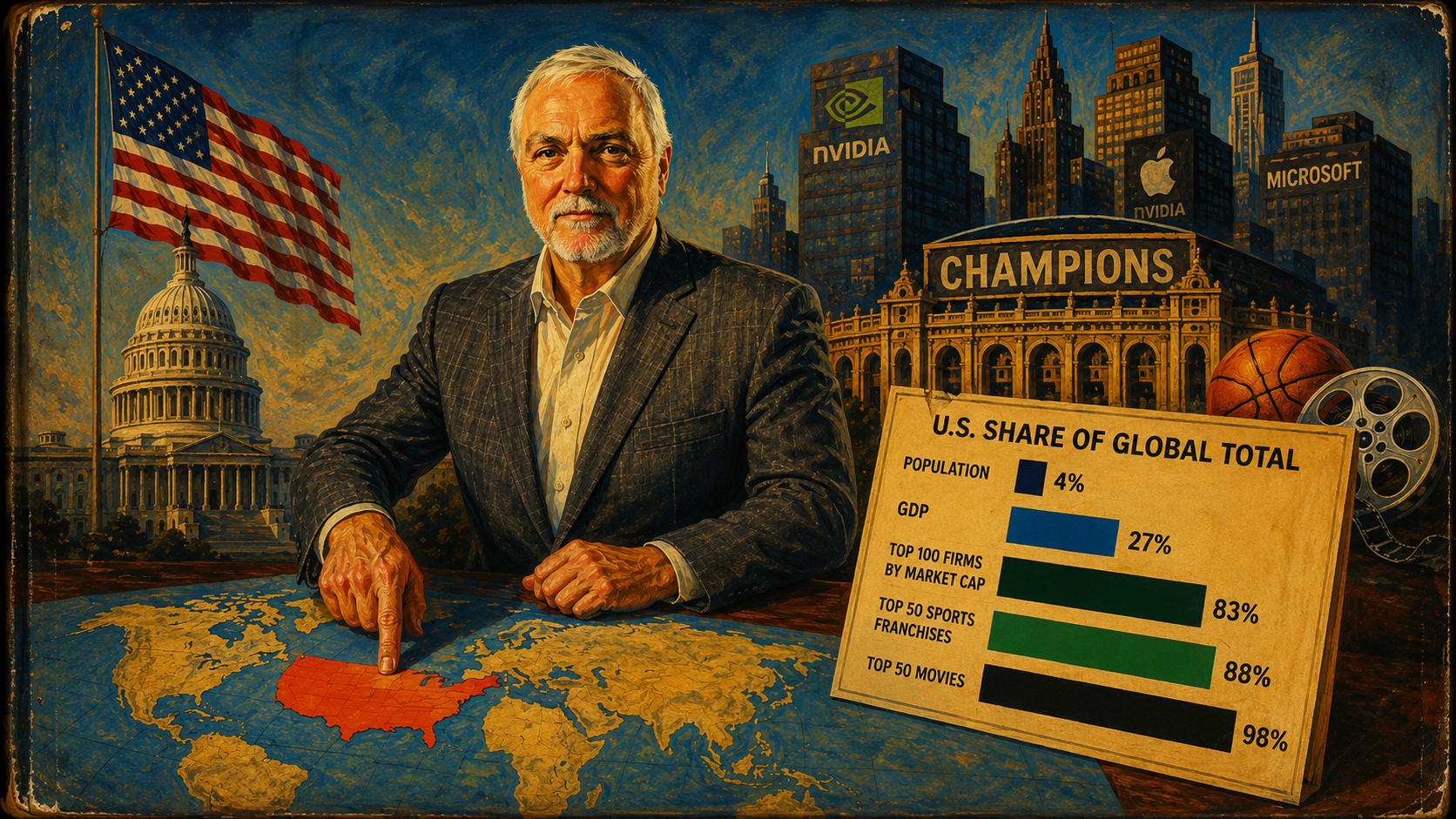
Start with the movies. Take the fifty highest-grossing films ever made — every blockbuster that ever packed a theater, ranked by the dollars they pulled in, right up through the spring of 2026. Now guess how many of those fifty came out of a single country. The answer is just about all of them. Ninety-eight percent. Out of the whole world's top fifty, near enough every last one flies the same flag.
Now the stadiums. There's a list, kept by Forbes, of the fifty most valuable sports franchises on the planet — the ball clubs and football teams worth more than some small nations. Of that top fifty, eighty-eight percent are American. The entire rest of the world, all of it together, splits what's left over.
Now the money itself. Take the hundred largest companies on earth by market value — the giants, the ones whose stock moves markets from Tokyo to London and back. Eighty-three of those hundred are American companies.
And the whole economy? One country produces about twenty-seven percent of everything the entire world makes in a year. More than a quarter of all the goods and services on a planet of two hundred nations. One of them, better than a fourth.
Movies, ninety-eight. Sports, eighty-eight. The biggest companies, eighty-three. The world's output, twenty-seven percent.
Now here's the rest of the story.
The country that does all of that... is four percent of the people. Four. Out of every hundred human beings walking this earth, ninety-six of them live somewhere else. This nation is a thin slice of all humanity — and it runs the box office, owns the stadiums, builds the biggest companies, and makes better than a quarter of the world's wealth.
Four out of a hundred. That's the whole American crowd. Now look at what the other ninety-six are watching, cheering, and buying.
Sit with that a moment. Because it isn't luck, and it isn't the land alone. Plenty of big, rich, crowded countries never came within a country mile of it.
So why? The same reasons we walked through last time — only grown up now, and compounded over two full centuries. Rules you can count on. A courtroom where the little fellow can beat the big fellow if he's in the right. A dollar the whole world trusts enough to hold in its own vaults. Universities that pull in the brightest minds from every corner of the globe and turn them loose to invent. And a hard, beautiful habit the economists call creative destruction — the willingness to let the old thing die so a better thing can be born. It's brutal. And it's the secret.
Now, I promised you straight talk, so here it comes. This is no victory lap. The nation carries a mountain of debt that climbs higher every single year, and one day the bill comes due. There's a giant rising in the East — China — that already out-manufactures us in raw tonnage. The factory jobs that once built the middle class have thinned out, moved on, gotten automated. And a country hollering at itself from both sides of the road can trip right over its own feet. None of that is small. An honest man keeps every bit of it on the ledger.
But I'll tell you what I believe. Every generation, somebody stands up and says America's best days are behind her. And every generation so far, she has proven them wrong — not by standing still, but by lighting out for new territory. The frontier used to be a line of trees at the edge of a farm. Now it's a chip smaller than your fingernail. An engine of artificial intelligence. A field of energy locked under the prairie. The frontier never closed. It just changed its clothes.
Four percent of the people. A quarter of the world's wealth. The whole magnificent thing built on an idea somebody scratched onto paper in a hot Philadelphia room — and a stubborn faith that a free person, left alone to build, will build something worth seeing.
And that's not a story about the past. It's a challenge for right now. Because whether the fifth century of this experiment shines the way the first four did — that won't be decided by the land, or the luck, or the numbers on some list.
It'll be decided by us. By the choices we make today.
And that... is the rest of the story.