Wednesday, July 1, 2026
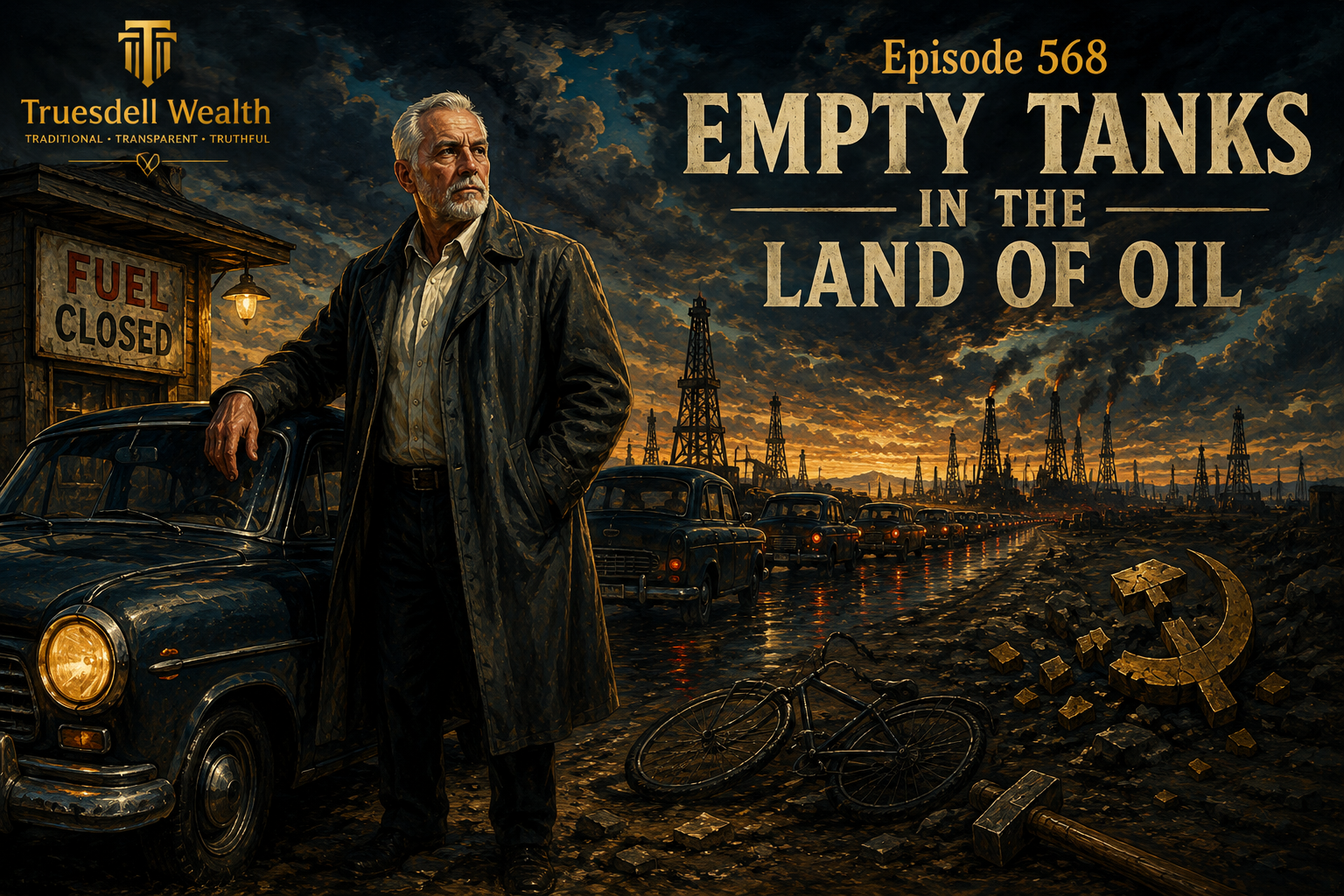
Empty Tanks in the Land of Oil
This blog post looks at a strange summer in Russia, a nation floating on some of the richest oil on earth, yet watching its own people wait hours, and sometimes overnight, to fill a tank. We trace how a war that stayed far away for three years finally arrived at the corner gas station, and what happens to a giant that leans all its weight on one leg. It's a story about strength, fragility, and the long view.
How the world's great oil power ended up sleeping in line for a tank of gas.
Picture a country so rich in oil it practically floats on the stuff. Now picture its own people sleeping in their cars overnight — just for the chance to fill the tank.
That's Russia this summer. And you and I both know there's a story in how a thing like that happens.
For most of the last three years, the war in Ukraine was something that happened somewhere else for the average Russian. A headline. A far-off thunder. Life in Moscow rolled on. The war the Kremlin started back in 2022 stayed, for most folks, on the far side of the television screen.
Then it came home. Not with tanks. With empty pumps.
Russia is a vast land. Eleven time zones. Frozen rivers and endless steppe and Siberian forest that swallows the horizon whole. It's the kind of country that can make a man feel small. And under all that ground sits some of the richest oil on this earth. For generations, that oil was the nation's strength — the thing it sold to the world, the muscle behind the throne.
But strength built on one thing is a brittle kind of strength. And here's what nobody in the Kremlin likes to say out loud. All that crude has to be refined before it can run a truck, or a tractor, or a taxi. And refineries — big, complicated, costly refineries — they don't move. They sit right where you built them. Out in the open. Waiting.
Ukraine figured that out.
For years now, Kyiv's been sending drones after those refineries. Early on, the damage got patched up fast. But this year the drones came in greater numbers — and they flew farther, and they hit harder. They reached a refinery in Tyumen, twelve hundred miles off, deep in Siberia. And on the eighteenth of June, a single raid broke clean through Moscow's air defenses and destroyed the capital's main refinery.
That was the turning point.
Within days, by one former industry man's estimate, close to a quarter of all Russia's refining capacity had gone dark. Not because of markets. Not because of speculators. Because the fuel simply wasn't being made anymore.
You can't pour crude oil in your tank. When the refineries go down, the pumps go dry — no matter how much wealth sleeps in the ground beneath your boots.
So the lines began. In Moscow — usually shielded from the war — stations shut their doors, and the ones still open had folks waiting for hours. Out in Siberia and the North Caucasus, people waited overnight, and longer. In one Siberian region, the government set out portable toilets beside fuel lines that ran for miles. Read that again. Portable toilets. Beside the line. Just to fill a tank.
Filling spare cans got banned across much of the country. Drivers were rationed to as little as five gallons at a turn. Whole regions started writing their own rules. One said it would sell fuel only to cars registered right there at home — and only once a week. In another, fistfights broke out at the pumps between locals and drivers who'd crossed over from Crimea, where sales to civilians had been shut off altogether.
Folks kept lists by hand. QR codes. Homemade rationing. And if you're old enough to remember the Soviet years, you know that feeling in your bones — the line, the wait, the grumble. It came right back.
At first, the authorities pinned it all on panic and speculators. Then the man at the very top said the quiet part out loud — the shortage was real. And when the fellow in charge steps up to talk about your gas tank himself, well — you know it's gotten serious.
And it isn't only the cars. It's the harvest. Out on the farms, the whole summer crop leans on diesel in the tractors. A country that can't fuel its own fields is a country that starts to worry about its bread.
Now here's the part worth sitting with.
For decades, Russia stood among the great fuel exporters of the world. It sold gasoline and diesel and jet fuel to nations far and wide. And now — for the first time in memory — the Kremlin says it may have to import fuel. Buy it. From somebody else. The seller, turned buyer.
And where would that fuel come from? The refiners big enough and close enough to help sit far away — India chief among them. A nation Russia once supplied may now be asked to supply Russia. Shipped by sea. Weeks on the water. Paid for out of a budget already stretched thin by the war itself.
That's the long view, friend. That's the land teaching a hard old lesson about self-reliance — that a giant leaning all his weight on one leg can be tripped.
They're reaching backward, too. Russia outlawed a low grade of gasoline called Euro-2 back in 2013 — it fouls up modern engines. Now they're talking about brewing it again, because at least it'll run the older cars. When a country starts un-banning the thing it outlawed a dozen years back, it isn't solving the problem. It's buying time.
And the price? Here's the sleight of hand. On paper, official gasoline in Moscow still runs cheap — under four dollars a gallon at the state-run stations. That's the story the authorities want told. They even started holding back the price statistics, and rounding up the so-called speculators.
But the real price tells the truth. On the black market in Crimea, gasoline was reported changing hands at twenty-five dollars a gallon. And in one Siberian region, people were said to be selling your place in line — just your spot, mind you — for the equivalent of four hundred fifty-four dollars. Not the fuel. The waiting.
The official price and the real price had parted ways. And when a government hides the number, people don't calm down. They stock up. They figure it's worse than they're being told. And more often than not, they're right.
All of this lands as Russia heads toward parliamentary elections this September. Nobody expects a free and fair vote. But even a crooked ballot gives people a quiet place to air a grievance. And a man who's waited two hours for gas doesn't forget it on his way to the polls.
Now, a fuel line is not a surrender. Russia's a big, tough country, and it's endured worse. Its leadership has shown no appetite for a ceasefire — not even one that would stop the strikes on its own refineries.
But there's an old truth out on the frontier, and it holds in Moscow just the same. The strongest-looking thing tends to break at the seam nobody was watching. A nation floating on an ocean of oil — brought to a standstill not at the front line, but at the corner gas station.
You and I both know how any hard winter goes. People endure. They grumble. They wait. And they remember.
And that… is the rest of the story.