Tuesday, June 9, 2026
News Brief & Items We’re Following
The Truesdell Wealth Morning News Brief for Monday, June eighth, two thousand twenty-six.
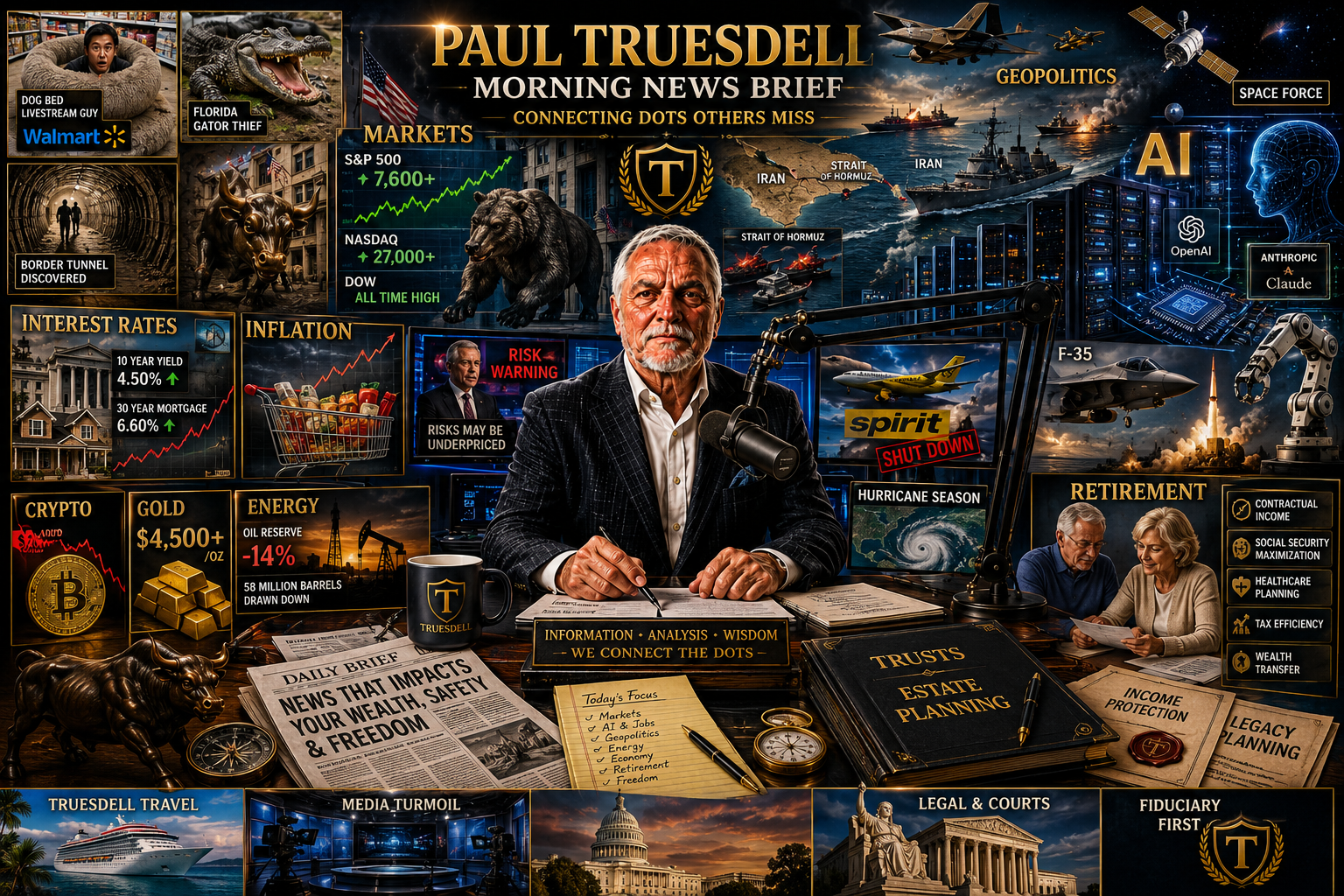
Let's begin with the markets, which whipsawed through one of their roughest stretches of the year. A sharp semiconductor selloff that began late last week, triggered by cautious artificial intelligence chip guidance from Broadcom and a deepening memory chip squeeze, sent the technology heavy Nasdaq down about four percent in a single session, with Advanced Micro Devices and Intel each shedding roughly eleven percent. Today the major chip names clawed back a good portion of those losses and crude oil eased from its overnight highs as traders weighed fresh Middle East fighting. Investors are now bracing for the May reading on consumer prices, due Wednesday, which could shape how soon the Federal Reserve moves on interest rates.
Next, the labor market sent a complicated signal. The May employment report showed the economy adding about one hundred seventy-two thousand jobs, roughly double what economists had expected, while the unemployment rate held at four point three percent. Bond yields jumped on the news, with the ten year Treasury note climbing to around four and a half percent, as a hotter than forecast jobs picture revived fears that the central bank may have to keep rates high or even raise them. It was a classic case of good news for workers being read as bad news for stocks.
Next, a mystery suitor stirred the media world, as an unnamed bidder described only as a single large company put forward a roughly twenty five billion dollar offer for select assets of Warner Brothers, sending the entertainment giant's shares lower as analysts tried to guess the buyer's identity. The approach lands amid a broader wave of consolidation talk across film, streaming, and broadcast television. Several other deal stories drew scrutiny as well, including senators urging close antitrust review of a major real estate brokerage combination.
Next, in business coverage from elsewhere, an industrial conglomerate told investors it expects to absorb the financial hit from the Iran conflict as it bets the war is gradually de-escalating, a notably optimistic read given the weekend's renewed strikes. Separately, a sweeping new international assessment warned that climate change and pollution are pushing the world's oceans toward a tipping point, pointing to dying coral reefs and depleted fish stocks as signs of grave risk to marine health. Another theme drawing attention was a coming wave of European public offerings heavily weighted toward defense companies, reflecting the continent's rapid military buildup.
Next, cryptocurrency took a beating even as a fresh enthusiasm bubbled up on Wall Street. Bitcoin extended its slide, dropping another two and a half percent and dragging down crypto linked equities such as the large corporate Bitcoin holder formerly known as MicroStrategy, now called Strategy, along with major exchange operators. Yet even as the original digital coin sold off, market commentators noted a new wave of institutional crypto products and offerings gaining momentum, suggesting appetite for the asset class has shifted rather than vanished.
Next, market strategists turned cautious on valuations after the long run up. One widely followed research outfit published a list of stocks it now considers overpriced heading into the summer, while continuing to argue that Broadcom remains attractively valued given its long term artificial intelligence chip growth. Strategists also flagged that the probability of a Federal Reserve interest rate increase later this year, while still below even odds, has been climbing as war driven energy costs feed into inflation.
Next, retail and consumer companies offered a steadier counterpoint to the chip turmoil. A major uniform and facilities services provider raised its full year revenue outlook to more than eleven billion dollars as operating margins hit a record, and a leading restaurant operator outlined sales growth targets in the range of eight and a half to roughly nine percent for its new fiscal year as it expands its flagship Italian dining brand and accelerates new openings. The results suggested that, away from the technology rotation, parts of the everyday economy remain resilient despite stubborn inflation.
Next, the White House has been moving aggressively on artificial intelligence. The President signed a national security memorandum directing the intelligence and defense establishment to accelerate adoption of advanced artificial intelligence, adapting the best commercial and open systems for mission use while insisting that fielded tools remain controllable and accountable, building on a May agreement to put capabilities from eight leading artificial intelligence companies onto classified military networks. He paired that with a separate action to promote advanced artificial intelligence innovation and security at home. Together the moves are pitched as cementing American leadership in the technology.
Next, the President overhauled trade rules on strategic metals, signing a proclamation that trims tariffs on farm equipment such as combines and harvesters from twenty-five percent down to fifteen percent, and extends a fifteen percent rate to mobile industrial machinery like bulldozers and forklifts from trade-deal partners. Foreign manufacturers can qualify for a lower ten percent duty if their capital equipment is at least eighty-five percent American melted and poured steel or aluminum by weight, with the changes set to run through the end of two thousand twenty-seven. The administration says the country became the world's third largest steel producer last year and that manufacturing in May grew at its fastest pace in four years, a fifth straight month of expansion.
Next, a sweeping customs enforcement order was signed to crack down on duty evasion and importer fraud. It directs the homeland security department and the customs and border agency to raise bonding requirements for importers of record, impose tougher rules on foreign importers, and set a fifty percent minimum penalty floor for those who break customs law. The action builds on the earlier suspension of the so-called minimal-value shipping loophole, whose statutory basis is now slated for permanent repeal in the middle of two thousand twenty-seven. Officials framed it as long overdue modernization to protect both revenue and national security.
Next, the President also enacted an order making senior federal leaders more directly accountable, reclassifying roughly eight thousand policy-influencing positions while keeping them as career jobs, and issued a presidential message marking the anniversary of the Normandy landings as part of the nation's two hundred fiftieth anniversary commemorations. The workforce move continues a broader push to reshape the civil service. The wartime tribute honored the veterans of that invasion against the backdrop of renewed conflict overseas.
Next, the intelligence community has new leadership at the top, as the President named the federal housing finance director, William Pulte, to serve as Acting Director of National Intelligence, a choice that drew quick praise from allied lawmakers who cited his record overseeing more than ten trillion dollars in housing finance assets and sensitive data. Supporters cast him as an outsider reformer brought in to shake up the agencies. The appointment fills the post amid the ongoing Middle East crisis and heightened global threats.
Next, at the central bank, officials voiced growing worry that the war could entrench inflation rather than pass quickly. The president of the Cleveland regional Federal Reserve bank described the energy shock as the fourth major disruption in five years, after the pandemic, the war in Ukraine, and tariffs, and noted oil costs are reaching consumers unusually fast. With the May reading on consumer prices due this week, policymakers are widely expected to hold interest rates steady while leaving a possible increase on the table.
Next, the Department of Defense, now operating under the revived name the Department of War, continued its push to embed artificial intelligence directly with warfighters, following last month's agreements to deploy commercial systems on classified networks. Leaders have described placing advanced tools in the hands of commanders as a step toward making the United States the premier artificial intelligence-enabled fighting force. This rides atop the largest military budget request in modern history, detailed later in this brief.
Next, the State Department spent the week defending steep cuts before Congress, with the Secretary of State pressing lawmakers to accept a budget that would shrink the department by roughly thirty-three percent, arguing foreign policy should serve American interests first and drawing sharp objections that the reductions would weaken diplomacy during a war. He also highlighted a growing coalition, now numbering fourteen countries, cooperating to protect the supply chains critical to artificial intelligence, and urged Americans in the Middle East to heed embassy guidance as the regional fighting flared again. The testimony underscored the tension between the administration's cost-cutting and its expanding global commitments.
Next, among the day's most prominent headlines, the State of Florida has taken a striking legal step, with its attorney general filing what is described as the first state led lawsuit against the maker of ChatGPT and its chief executive over the company's alleged links to violent incidents, a case being watched closely along the Gulf Coast and nationally. The suit adds to mounting legal and regulatory pressure on the artificial intelligence industry. It also underscores how quickly questions about the technology's real world harms are reaching the courts.
Next, a diplomatic rift between Washington and London drew wide coverage after Britain's deputy prime minister said he had told the American Vice President to his face that he was wrong to blame immigration for the death of a university student who had been handcuffed while dying of a stab wound. The unusually blunt exchange between close allies highlighted growing friction over migration rhetoric. British officials made clear they considered the comments out of bounds.
Next, the war's reach into household budgets remained a leading consumer story, as new data showed grocery and energy costs climbing, with meat, produce, and especially tomato prices rising sharply, while the average rate on a thirty year fixed mortgage moved up to roughly six and a half percent from just under six percent before the conflict. Economists cautioned that some of the steepest food price increases may not fully arrive until the fall harvest reaches market. For many families, the squeeze is already showing up at the gas pump and the checkout line.
Next, marijuana stocks tumbled in reaction to a federal move to reschedule cannabis, a development that scrambled expectations across the industry and sent shares of growers and retailers sliding as investors tried to parse the policy's winners and losers. The order touches a sector that has long pushed for looser federal treatment. Its market impact today was decidedly negative.
Next, to international affairs, where the dominant development was the most serious Middle East fighting since the spring truce. Israel and Iran traded direct missile fire on Monday for the first time since an April eighth ceasefire, after Israel struck the southern suburbs of Beirut over the weekend in defiance of an American request to stand down, prompting three waves of Iranian missiles toward central Israel. Yemen's Houthi rebels launched a missile at Israel and threatened Red Sea shipping, while Iran's joint military command said it was halting offensive operations but warned of far more crushing measures if attacks continued. The flare up, coming as the war passed its one hundredth day, threatened to unravel a tentative deal to extend the underlying ceasefire.
Next, the European Union responded to the Middle East crisis with new penalties, as the bloc's foreign policy chief announced sanctions against Iranian individuals and entities accused of disrupting transit through the Strait of Hormuz, the vital waterway that normally carries about a quarter of the world's seaborne oil and has been largely closed for roughly one hundred days. The measures followed a meeting of European defense ministers. They signaled Europe's intent to keep economic pressure on Tehran even as it urges restraint on all sides.
Next, in the Caucasus, Armenia's prime minister declared victory in Sunday's parliamentary election, with his governing party winning close to fifty percent of the vote amid the country's highest turnout in years, in a contest framed as a choice between deeper ties to Europe and a return toward Russia. The result hands him a strong mandate to continue steering the country westward. Pro Russian forces fell well behind.
Next, the leader of China arrived in North Korea for a two day state visit, his first international trip of the year and only his second ever to Pyongyang, where a cheering crowd greeted him in the capital's main square. The trip underscores deepening coordination among Beijing, Moscow, and Pyongyang. It comes at a moment of heightened global tension over the Middle East and Ukraine.
Next, on Ukraine, the leaders of the United Kingdom, France, Germany, and Ukraine met in London and issued a joint statement laying out five conditions they say must be met for what they called a just and lasting peace with Russia. At nearly the same time, Russia's foreign minister dismissed negotiations, declaring that soldiers, not talks, will ultimately decide the war's outcome. Ukrainian forces, meanwhile, pressed a long range strike campaign against Russian air defenses and military infrastructure.
Next, Russia's president used his showcase economic forum in Saint Petersburg to vow stronger air defenses against Ukrainian drone attacks that have struck deep inside Russian territory. The strikes have embarrassed Moscow and disrupted civilian air traffic. His remarks sought to project confidence even as the home front feels the war's reach.
Next, in South America, Peru held a tense presidential runoff on Sunday between the conservative leader of the Popular Force party and a left leaning congressman allied with a former president, capping years of impeachments, corruption scandals, and political upheaval. Votes were still being tallied as results came in. Whoever prevails will inherit a deeply divided country and fragile democratic institutions.
Next, neighboring Colombia's presidential campaign turned grim, with one hard right candidate addressing supporters from inside a bulletproof booth, a vivid illustration of the security fears stalking the race after earlier political violence. Candidates across the spectrum have grown wary of large public gatherings. The imagery captured a campaign conducted under threat.
Next, in the Pacific, the Philippines was rattled by fresh seismic tremors, the latest in a series striking just months after the country endured its strongest earthquake in more than a decade. Authorities urged residents in affected areas to remain cautious about aftershocks and structural damage. The repeated quakes have kept disaster response agencies on alert.
Next, across Europe a cluster of policy moves drew notice, as the European Union signaled it wants to accelerate the arrival of self driving robotaxis on the continent, even as seven member states pushed Brussels to hold firm on strict automobile emissions rules. The competing impulses captured Europe's balancing act between embracing new technology and defending its environmental commitments. Regulators face pressure from industry and climate advocates alike.
Next, to United States military and procurement matters. The centerpiece remains the Golden Dome missile defense initiative, an ambitious shield meant to counter ballistic, hypersonic, and cruise missiles as well as drones, with a flexible contracting vehicle valued at up to one hundred fifty one billion dollars now spread across more than two thousand four hundred companies competing for future task orders. The architecture leans heavily on space based interceptors and remains largely classified. The program reflects a broader shift toward awarding many vendors small prototype contracts before consolidating into far larger production deals.
Next, the Navy is being reshaped around what the President has dubbed a Golden Fleet, anchored by a new line of large surface combatants, with more than sixty five billion dollars earmarked to build eighteen warships and sixteen support ships in the coming fiscal year. Officials called it the most significant shipbuilding commitment in more than six decades. The buildup is pitched as a response to one of the most dangerous threat environments in the nation's history.
Next, autonomous warfare is drawing unprecedented investment, with the Pentagon devoting tens of billions of dollars to drone swarms, contested logistics, and counter drone defenses, alongside advanced systems such as collaborative combat aircraft and carrier based refueling drones. Defense leaders describe this as a generational bet on uncrewed systems. The push reflects lessons from the war in Ukraine and the recent Middle East fighting, where drones and missiles have dominated.
Next, the military is moving quickly on containerized and hypersonic strike weapons, beginning purchases this month of test missiles from four firms while laying the groundwork for a multiyear deal to buy at least five hundred hypersonic strike missiles annually from a defense startup once its weapon is validated. Containerized launchers, hidden inside standard shipping containers, are prized as a low cost, mobile way to deploy firepower. The contracts signal a faster, more commercial approach to arming the force.
Next, the regional fighting has strained American munitions stockpiles and exposed the limits of the defense industrial base. Defensive interceptors and offensive munitions used in the Middle East are slow to replenish, a concern echoed repeatedly in budget testimony as officials warned that years of underinvestment have left supply chains fragile. The pressure is reinforcing the case for the largest military outlay in modern history, a request of about one and a half trillion dollars, a roughly forty two percent increase over the prior year.
Next, to Silicon Valley, technology, and artificial intelligence. The chipmaker Nvidia used its conference in Taiwan to push beyond the data center and into personal computers, unveiling a powerful new laptop and desktop chip and declaring that it and Microsoft intend to reinvent the personal computer, a move that sent shares of rival chipmakers lower. The announcement marked the company's boldest attempt yet to dominate every layer of the artificial intelligence hardware stack. New machines using the chip from major manufacturers are expected later this year.
Next, Nvidia also named its first major customers for a brand new central processor, its first ever designed entirely from scratch, with the makers of Claude, ChatGPT, and the rocket company SpaceX confirmed as early adopters. The chip is said to run nearly twice as fast as comparable processors from Intel and Advanced Micro Devices for artificial intelligence agent tasks, and it pairs with the company's newest graphics processors as Nvidia chases a five hundred billion dollar sales target. Full production is slated for the third quarter, with a major cloud provider first in line to deploy it at scale.
Next, the artificial intelligence company that builds Claude has moved toward a public listing, with filings pointing to a valuation in the neighborhood of nine hundred sixty five billion dollars, a figure that would rank among the largest technology debuts ever. The step comes amid a broader rush of marquee offerings, including a historic public listing by the rocket company SpaceX. The activity underscores how investor appetite for artificial intelligence and space ventures remains intense even amid market turbulence.
Next, the cost of running artificial intelligence is becoming its own battleground, as a growing focus on so called model routing, which sends simpler requests to cheaper models, threatens the revenue of the largest artificial intelligence developers. The trend highlights mounting pressure to rein in the enormous expense of operating frontier systems. It is reshaping how companies think about pricing and efficiency.
Next, the competitive landscape kept shifting on multiple fronts, with Nvidia having overtaken Apple to become one of the world's most valuable companies, new rival video generation models emerging from China to challenge American offerings, and insiders at a leading laboratory raising fresh concerns about oversight and safety. Voice and audio generation tools also advanced, with new text to sound systems impressing creators. Taken together, the week reflected an industry sprinting forward while wrestling with questions of cost, control, and accountability.
Next, to close, three stories from the lighter and more bewildering side of the news. In Florida, a man was arrested after authorities say he stole a radiological device worth around twenty thousand dollars, the kind of instrument used to measure soil density, and then promptly listed it for sale on an online marketplace, which is roughly the digital equivalent of leaving a signed confession at the scene. It is a reminder that the getaway plan matters at least as much as the heist.
Next, also in Florida, a woman pulled over during a routine traffic stop reportedly watched a bag of cocaine tumble onto the floorboard and, thinking fast but not well, insisted to the officer that it was, in her words, her feminine product. Deputies were unpersuaded by the explanation. The episode joins a long and storied tradition of improvised roadside excuses that fool absolutely no one.
Next, in a domestic dispute worthy of a cautionary tale, a couple's argument in Pennsylvania escalated until a sizable chunk of their own house had been torn away by an excavator, leaving investigators worried about whether the structure would even remain standing. No marriage counselor recommends heavy machinery as a conflict resolution tool. It stands as a vivid lesson that some arguments are best settled before someone reaches for the keys to a backhoe.